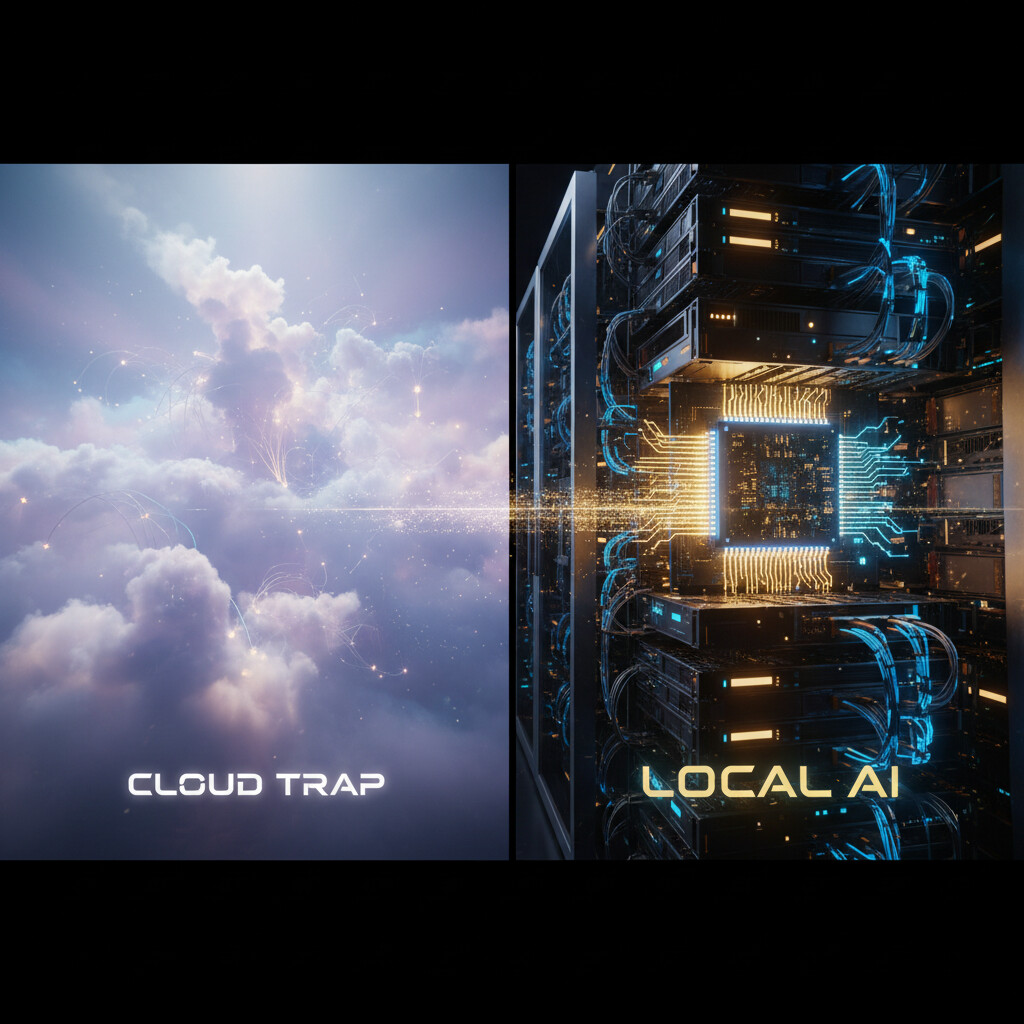
The ‘Cloud-Only’ Trap: Why Local AI is the New Enterprise Standard
Still relying solely on massive cloud LLMs for every minor task? That is like bringing a knife to a laser fight. While the world was busy marveling at the sheer scale of trillion-parameter cloud giants, a massive, expensive, and slow gap emerged in the enterprise stack: the inability to deploy sophisticated, reasoning-capable agents without sacrificing privacy, incurring massive latency, or bleeding cash through per-token fees.
The era of the "Cloud-Only" mandate is ending. As we move through 2026, the smart money is shifting toward local, open-weight models that live where the data lives. This is not just a trend; it is a structural necessity for the next generation of agentic workflows.
The Problem: The Hidden Tax of the Cloud
For most enterprises, the "Cloud-First" AI strategy has hit a wall of diminishing returns. When you deploy AI agents that need to execute code, browse local files, or interact with real-time industrial sensors, the cloud becomes a bottleneck. Consider these three friction points:
- The Latency Tax: While local inference can stay under 50ms, cloud inference often fluctuates between 200ms and 2 seconds depending on network jitter. For high-frequency agentic tasks, that delay is a dealbreaker.
- The Predictability Gap: Cloud costs are volatile. Scaling a high-volume workload can lead to astronomical, unpredictable monthly invoices.
- The Sovereignty Risk: Sending sensitive proprietary data to a third-party API for every reasoning step is a compliance nightmare that many legal departments are no longer willing to sign off on.
The Solution: Granite 4.2 and the Rise of Open Weights
The breakthrough comes from the democratization of high-reasoning models. IBM's release of Granite 4.2 marks a pivotal moment in this shift. Unlike the monolithic black boxes of the past, these open-weight models are designed specifically for the enterprise agentic era.
Granite 4.2 is not just another chatbot. It is a reasoning engine. With the 30B model hitting impressive benchmarks like 57.00 on SWE-bench Verified and 89.17 on AIME25, it brings developer-grade coding and reasoning capabilities directly to your local infrastructure. Because these are open-weight models, you can deploy them on your own edge devices, private servers, or hybrid clouds, giving you total control over the model's execution.
The Data: Why Local AI Wins on ROI
The shift to local and hybrid AI is backed by staggering numbers. The economic argument is no longer theoretical; it is measurable.
- Massive Cost Reductions: Moving high-volume workloads to local AI infrastructure has been shown to reduce 24-month Total Cost of Ownership (TCO) by up to 62.9%. In some extreme cases, public-sector deployments have seen cost savings of up to 98% for token-heavy tasks, as seen in this case study.
- Hybrid Efficiency: A fleet of AI-enabled PCs in a hybrid setup can yield 40% to 60% savings over a three-year period compared to a cloud-only approach, according to recent industry analysis.
- Performance Gains: By keeping inference local, organizations can bypass the 1 to 2 second latency spikes common in cloud-based agentic loops, ensuring that AI agents act in near real-time.
The Bottom Line
The "Cloud-Only" trap is real. If your AI strategy depends entirely on external APIs, you are building on rented land with a high toll road attached. By leveraging open-weight powerhouses like IBM Granite 4.2, enterprises can finally deploy agentic AI that is fast, private, and—most importantly—economically sustainable.
Stop paying the cloud tax. Start building on the edge.