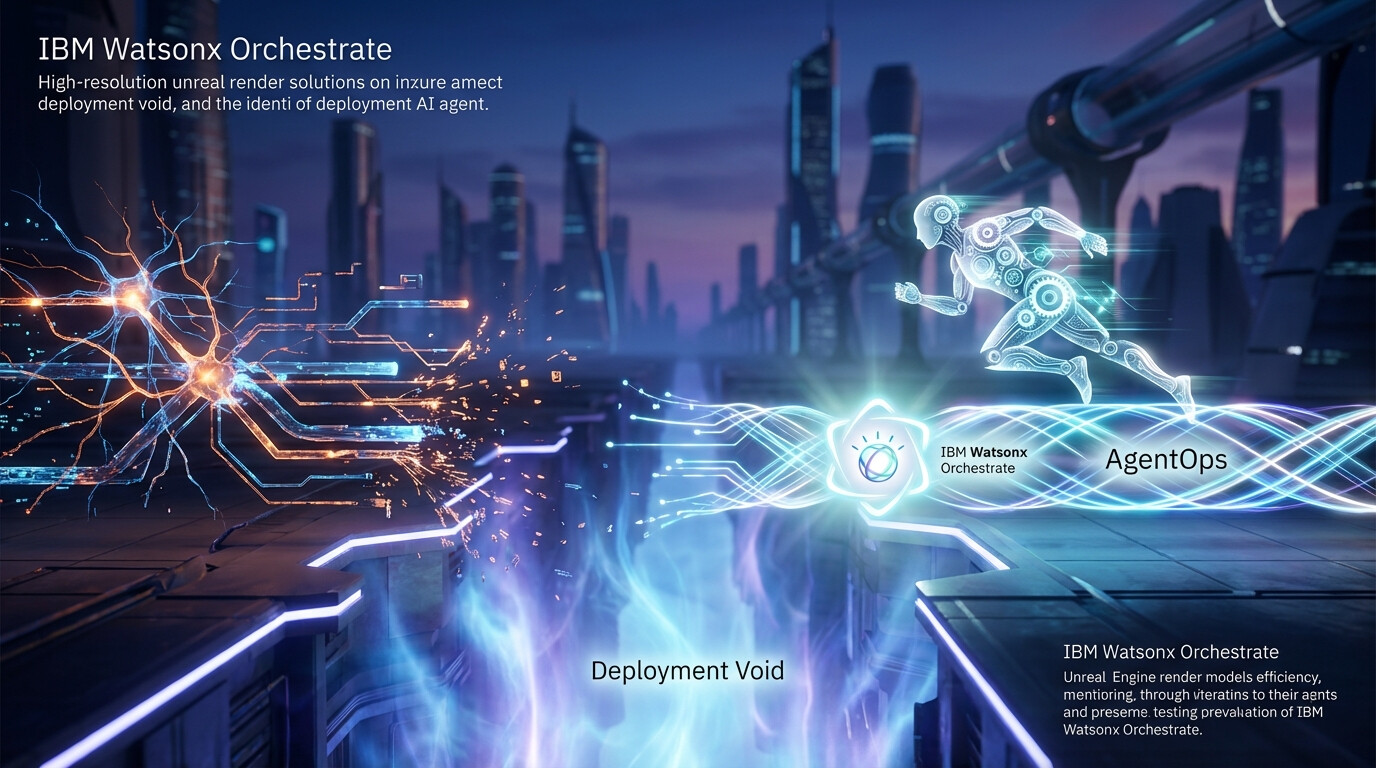
Still deploying AI agents like they’re stateless microservices? That’s like bringing a knife to a laser fight. While developers have mastered building AI agents locally, the moment they try to ship them to production, they hit a wall. Traditional CI/CD pipelines were never designed for autonomous agents that remember, plan, and evolve. Welcome to the deployment void.
The Problem: CI/CD Wasn't Built for This
Here's the dirty secret: your DevOps pipeline is failing you. Traditional continuous integration and deployment workflows excel at shipping stateless code, but AI agents are fundamentally different beasts. They require session management, complex state handling, and what the industry calls "Day 2 operations" (ongoing monitoring, retraining, and governance).
According to recent research, 80% of enterprises miss their AI budget forecasts in 2026, largely due to unforeseen infrastructure complexities. The challenges are real:
- Statefulness: Agents maintain memory and context across interactions, unlike stateless functions that execute and forget.
- Non-determinism: The same input can yield different outputs, making traditional testing frameworks useless.
- Tool Dependencies: Agents interact with external APIs, databases, and services dynamically, creating unpredictable failure modes.
- Security Risks: Autonomous decision-making introduces vulnerabilities that standard security scans can't catch.
As ZBrain's AgentOps guide explains, "Legacy DevOps and MLOps are unfit for evolving autonomy." You need observability into reasoning chains, token budgets, latency SLOs, and the ability to roll back when your agent starts hallucinating in production.
The Shift to AgentOps: A New Paradigm
Enter AgentOps, the operational framework designed specifically for deploying, monitoring, and managing autonomous AI agents. Think of it as DevOps meeting MLOps, then adding a layer of governance and behavioral testing on top.
The recent integration of GitLab with Google Agent Engine highlights this evolution. GitLab Duo now extends traditional CI/CD with agent-specific capabilities: model versioning, behavioral evaluations, non-deterministic testing, and containerized rollouts. Meanwhile, Azure AI Foundry offers end-to-end lifecycle management with canary deployments and blue-green strategies tailored for agents.
Key components of modern AgentOps pipelines include:
- Orchestration Frameworks: Tools like LangGraph, ReAct, and CrewAI handle task planning, memory, and multi-turn interactions.
- Behavioral Testing: Golden tasks, accuracy benchmarks, and simulations validate outputs that aren't deterministic.
- Observability: Traces of reasoning chains, tool calls, token usage, and latency (p50/p95) for debugging.
- Governance: Guardrails, human-in-the-loop approvals, refusal policies, and audit trails ensure safety.
- Safe Rollout Patterns: Canary (5-10% traffic), shadow mode, and automated rollbacks based on error rates.
Over 120 tools now populate the AgentOps landscape, spanning orchestration, monitoring, and enterprise platforms.
IBM's Answer: Watsonx Orchestrate
IBM recognized this gap early. Watsonx Orchestrate is purpose-built for enterprise AI agent deployment, offering both no-code builders for business users and an Agent Development Kit (ADK) for developers. It's not just about building agents; it's about deploying them with governance, accountability, and clarity.
The platform includes:
- 150+ Pre-built Agents: Deploy domain-specific agents immediately, reducing time-to-value from months to weeks.
- Agent Connect: Integrate external agents from any framework into your workflows.
- Governance First: Explainable, auditable agents with context injection and compliance features. Watsonx Orchestrate won both the 2025 Red Dot and iF Design Awards for responsible enterprise AI.
- Hybrid Cloud Integration: Seamless deployment across IBM Cloud, AWS, and on-premises environments via webMethods Hybrid Integration.
- High-Speed Inference: Partnership with Groq delivers 70% lower deployment risk and 40% faster prototyping through LPU architecture.
Real-world deployments validate the approach. CrushBank built an IT-service platform using Watsonx Orchestrate's hybrid, agentic architecture, demonstrating production-scale viability.
The Economics of Getting Deployment Right
The cost of getting AI deployment wrong is staggering. Enterprise AI deployments typically run $150,000+ for initial setup, with annual maintenance adding 15-30% on top. But hidden costs lurk in failed deployments, security breaches, and agents that behave unpredictably in production.
Deployment and infrastructure represent 15-20% of total AI project budgets, according to 2026 cost analyses. The breakdown:
- Basic Pilots: $5,000 to $25,000 initial setup + 15-25% yearly for monitoring and retraining.
- Enterprise Solutions: $150,000+ for integration, plus $10,000 to $50,000 annually for cloud and GPU infrastructure.
- Data Preparation: Often consumes 25-50% of budgets, a cost that compounds when agents fail in production.
The infrastructure demands are brutal. AI data centers may consume 1,050 TWh of electricity by 2026, while Q2 2025 compute spending hit $82 billion (166% year-over-year growth). Goldman Sachs projects AI companies will invest over $500 billion in 2026 alone.
Getting deployment right the first time matters. Platforms like Watsonx Orchestrate reduce risk through phased rollouts, behavioral testing, and governance that catches issues before they reach production. The alternative? Joining the 80% of enterprises that miss their AI forecasts.
What's Next: The AgentOps Maturity Curve
We're witnessing the birth of infrastructure for autonomous systems. The shift to AgentOps isn't optional; it's survival. As agents move from prototypes to production workloads in insurance claims, legal review, and logistics, the gap between local development and production deployment will only widen for those using legacy pipelines.
The winners in 2026 and beyond will be organizations that treat agent deployment as a first-class engineering discipline. That means specialized pipelines, observability into agent behavior, governance frameworks, and platforms built for statefulness from the ground up.
The deployment void is real. But the tools to bridge it, from GitLab Duo to Google Agent Engine to IBM Watsonx Orchestrate, are finally here. The question isn't whether you'll adopt AgentOps. It's whether you'll do it before your competitors.