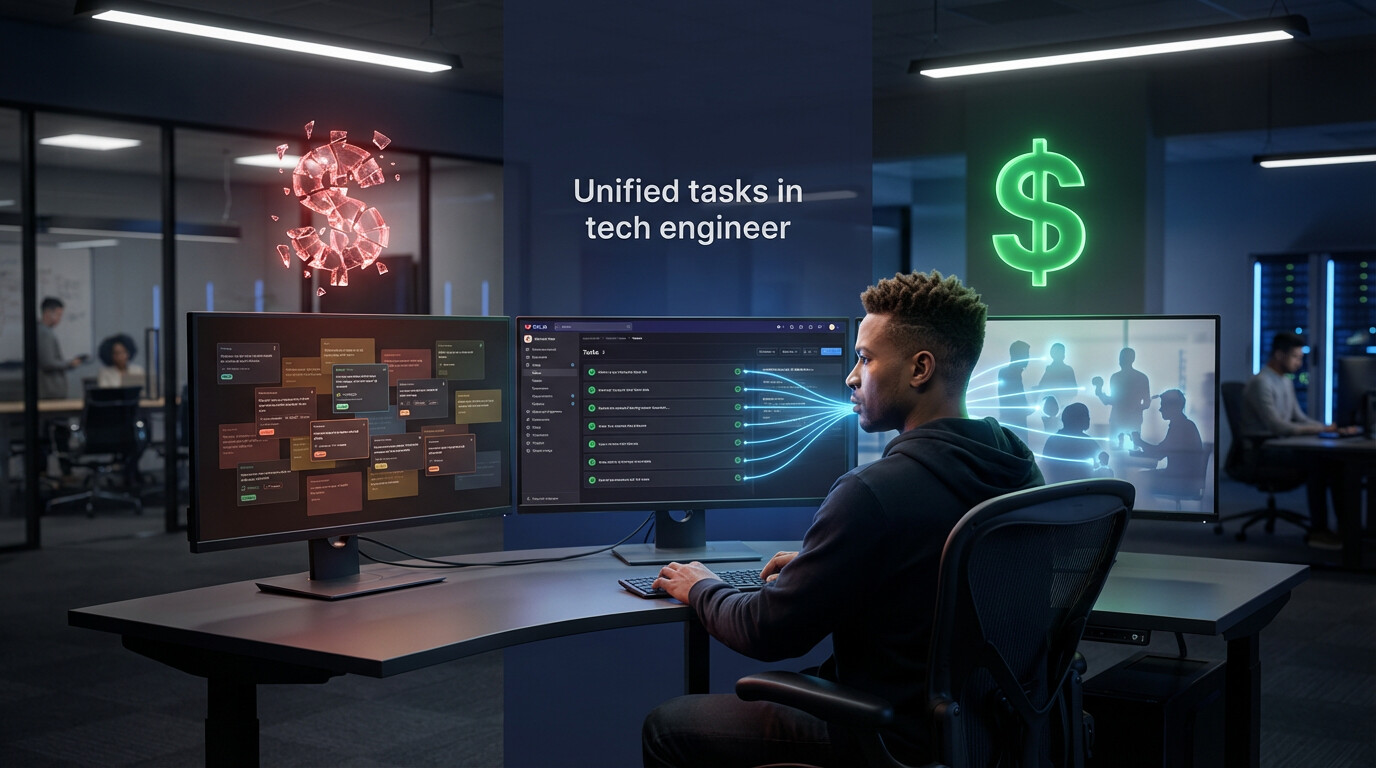
Spending two hours a day toggling between separate Epics and Issues pages? That’s not planning. That’s productivity theater. And it’s costing your organization roughly $50,000 per developer annually.
Welcome to the fragmentation tax: the hidden cost of managing work across siloed backlogs, constantly reconfiguring filters, and losing 23 minutes of focus every time you context switch. With GitLab 18.10's unified work items and saved views now generally available, the industry is finally waking up to a brutal truth: fragmented planning isn't just annoying. It's financially devastating.
The Problem: Death by a Thousand Switches
Let's talk numbers. Recent research shows developers switch contexts every 40 seconds, with 59% of daily tasks requiring context switches. Worse? Teams never resume 29% of interrupted tasks. For engineering managers juggling Agile ceremonies, sprint planning, and backlog grooming across disconnected systems, the overhead compounds exponentially.
The traditional approach forces teams into separate silos:
- Epics live here (one interface, one set of filters)
- Issues live there (different page, reset your filters)
- Tasks, objectives, test cases? Good luck finding a unified view
Every switch between these pages burns cognitive fuel. UC Irvine researchers found it takes 23 minutes to regain full focus after an interruption. Multiply that across 20 to 50 daily switches, and you're hemorrhaging 4+ hours per developer per day. That's not an exaggeration. That's $450 billion annually across the knowledge worker economy.
For a 10-person engineering team? You're looking at $500,000 in lost productivity. For 100 developers? Over $5 million evaporated into admin tax.
The Solution: Consolidate Your Planning Stream
GitLab 18.10 tackles this head-on by eliminating artificial boundaries between work artifact types. The new Plan > Work items interface combines epics, issues, tasks, objectives, key results, and test cases into a single, unified list experience.
Here's what that means in practice:
- One view, all work types: No more toggling between Issues and Epics pages. Everything lives in the same sortable, filterable stream.
- Saved views: Configure your filters once (by assignee, label, status, custom fields) and save them at the namespace or user level. Your team gets standardized views; you get back those lost hours.
- Flexible hierarchies: Markdown task checkboxes in tables, relationship mapping, and future support for board/hierarchy views give you the structural depth Agile teams need without the navigation overhead.
- Work Items REST API: Programmatic access unlocks migrations, integrations, and automation workflows that were previously blocked by fragmented endpoints.
This isn't just a UI tweak. It's foundational infrastructure. GitLab's unified work items architecture (launched in 2024 and matured through 18.10) standardizes how teams plan across the entire DevOps lifecycle, from strategic objectives down to individual test cases.
The Business Case: Velocity Meets ROI
IBM's DevOps research shows that organizations using integrated planning and value stream management can cut MTTR by 80% and mitigate IT risks 90% faster. The key? Eliminating tool sprawl and consolidating workflows into unified platforms.
IBM DevOps Velocity, for example, uses value stream visualization with "dots" representing builds, issues, pull requests, and tests to identify bottlenecks across heterogeneous toolchains. By orchestrating pipelines and providing real-time analytics in a single pane of glass, teams prove ROI through measurable improvements: faster deployment velocity, reduced risk, and quantified value creation.
The pattern is clear. Whether it's GitLab's unified work items, IBM's value stream orchestration, or any platform-engineering approach in 2026, the winners are consolidating. They're investing in systems that reduce cognitive load, standardize team workflows, and replace admin tax with actual delivery capacity.
Consider the alternative cost structure:
- Fragmented tools: $50,000 per developer in lost focus time, plus tool licensing across 5 to 7 disparate systems
- Unified platform: Reduce context switches to elite levels (6+ focus hours per day vs. 4.2 median), yielding a 3,520% ROI and $64,000 net gain per developer after tooling costs
For teams already on GitLab, 18.10's unified work items deliver immediate value with zero migration overhead. For organizations evaluating platforms, this sets a new baseline expectation: if your planning tools force artificial silos, you're paying the fragmentation tax.
Looking Ahead: Platform Engineering and Elite Performance
The shift toward unified work items reflects broader DevOps trends in 2026. As IBM's 2026 DevOps Guide highlights, platform engineering is replacing fragmented toolchains with self-service, guardrailed systems that accelerate iteration without sacrificing governance.
GitLab's roadmap reinforces this vision. Future enhancements include project-level epics, advanced hierarchy views, and deeper value stream analytics. Combined with AI-native workflows (like Duo agents for code review and testing), these features position unified planning as the foundation for agentic DevOps, where intelligent automation handles routine orchestration while humans focus on strategic decisions.
The data backs it up. GitLab ranks first in 4 out of 6 use cases in the 2025 Gartner Critical Capabilities for DevOps Platforms, including advanced planning tools and value stream metrics. Organizations using these capabilities report shorter cycle times, higher deployment frequencies, and measurably better outcomes.
The Bottom Line
Fragmentation isn't a minor inconvenience. It's a structural tax on engineering velocity that compounds with every sprint, every quarter, every hire. The cost is measurable: $50,000 per developer annually, 4+ hours of lost focus per day, and millions in aggregate productivity losses for mid-sized teams.
Unified work items eliminate that tax by collapsing artificial boundaries between planning artifacts. GitLab 18.10's implementation delivers this through saved views, flexible hierarchies, and a consolidated interface that respects how teams actually work.
The question isn't whether to unify your planning stream. It's whether you can afford not to.
Ready to eliminate the fragmentation tax? Explore GitLab 18.10's unified work items and see how consolidating your backlog translates to measurable velocity gains. For broader DevOps optimization, check out IBM's DevOps solutions and value stream management frameworks that quantify the ROI of integrated planning.