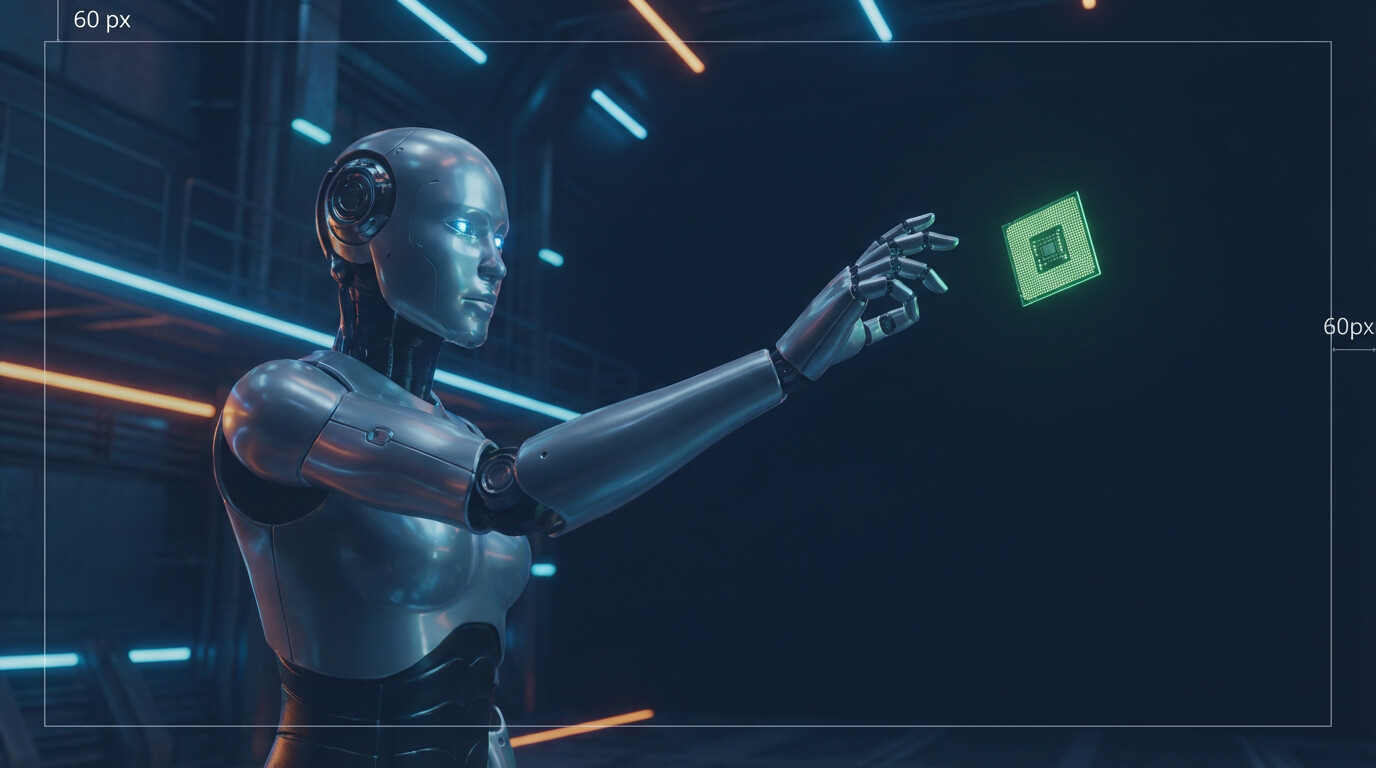
Language models can write poetry, debug code, and pass the bar exam. Meanwhile, your robot vacuum still gets stuck on a sock. Welcome to the physical AI paradox: while generative AI has conquered the digital realm, robots are still struggling with the basics. The culprit? A critical shortage of diverse training data that’s creating a “reality gap” preventing machines from generalizing even simple physical tasks.
The Data Drought Holding Robots Hostage
Here's the uncomfortable truth: while ChatGPT trained on trillions of text tokens scraped from the internet, robotics researchers are fighting over scraps. Collecting real-world robot data is expensive, time-consuming, and maddeningly fragmented. Each lab uses different hardware, different formats, and different tasks - making it nearly impossible to pool resources or build models that work across platforms.
The numbers tell a sobering story. The embodied AI market is projected to grow from $4.44 billion in 2025 to $23.06 billion by 2030, yet we're still grappling with fundamental data scarcity issues that don't plague other AI domains. Unlike computer vision (which had ImageNet) or NLP (which had Common Crawl), robotics has historically lacked the massive, standardized datasets needed to train generalizable models.
The Reality Gap: When Simulation Meets the Real World
The "reality gap" is the frustrating performance cliff that happens when a robot trained perfectly in simulation meets the messy, unpredictable real world. Your simulated robot arm might nail object manipulation 95% of the time in a virtual environment, only to fumble basic grasps when deployed on actual hardware.
Why? Because simulations, no matter how sophisticated, struggle to capture the full complexity of physics - friction variations, lighting changes, unexpected object properties, and the general chaos of reality. Techniques like domain randomization and transfer learning are improving sim-to-real transfer, but the gap remains stubbornly wide.
The Open X-Embodiment Revolution
Enter the cavalry: collaborative efforts to democratize robotics data. The Open X-Embodiment Dataset represents a landmark achievement - the largest open-source real robot dataset to date, containing over 1 million real robot trajectories from 22 different robot embodiments across 34 research labs and 21 institutions.
This isn't just about scale. The dataset covers 527 skills and 160,266 tasks, providing the diversity needed to train models that can actually generalize. Early results are promising: models trained on Open X-Embodiment show improved transfer capabilities and can learn new skills faster than those trained on isolated, single-robot datasets.
Synthetic Data: The Scalable Solution
While real-world data remains the gold standard, synthetic data generation is emerging as the practical path forward. Platforms like NVIDIA Isaac Sim enable researchers to generate vast quantities of training data at a fraction of the cost of physical data collection.
The economics are compelling. Traditional robot data collection can cost tens to hundreds of thousands of dollars per project, while synthetic data generation costs primarily involve computational resources. According to recent analyses, robotics validation engineers can save up to 46% of their time on testing and validation using synthetic approaches.
Gartner predicts that by 2030, synthetic data will completely overshadow real data in AI models. For robotics, the hybrid approach - pre-training on massive synthetic datasets, then fine-tuning on smaller real-world collections - is becoming the standard playbook.
The Path Forward: Standardization and Collaboration
The physical AI gap won't close overnight, but the trajectory is clear. Success requires three things:
- Data standardization: Unified formats and benchmarks that make sharing and combining datasets frictionless
- Open collaboration: More initiatives like Open X-Embodiment that pool resources across institutions
- Hybrid training pipelines: Intelligent combinations of synthetic and real-world data that maximize both scale and fidelity
The stakes are enormous. Morgan Stanley estimates that by 2040, the US alone may have 8 million working humanoid robots with a $357 billion impact on wages. But getting there requires solving the data problem first.
Language models had their ImageNet moment. Now it's robotics' turn. The question isn't whether we'll solve the physical AI data gap - it's how quickly we can standardize, share, and synthesize our way to robots that actually work in the real world.