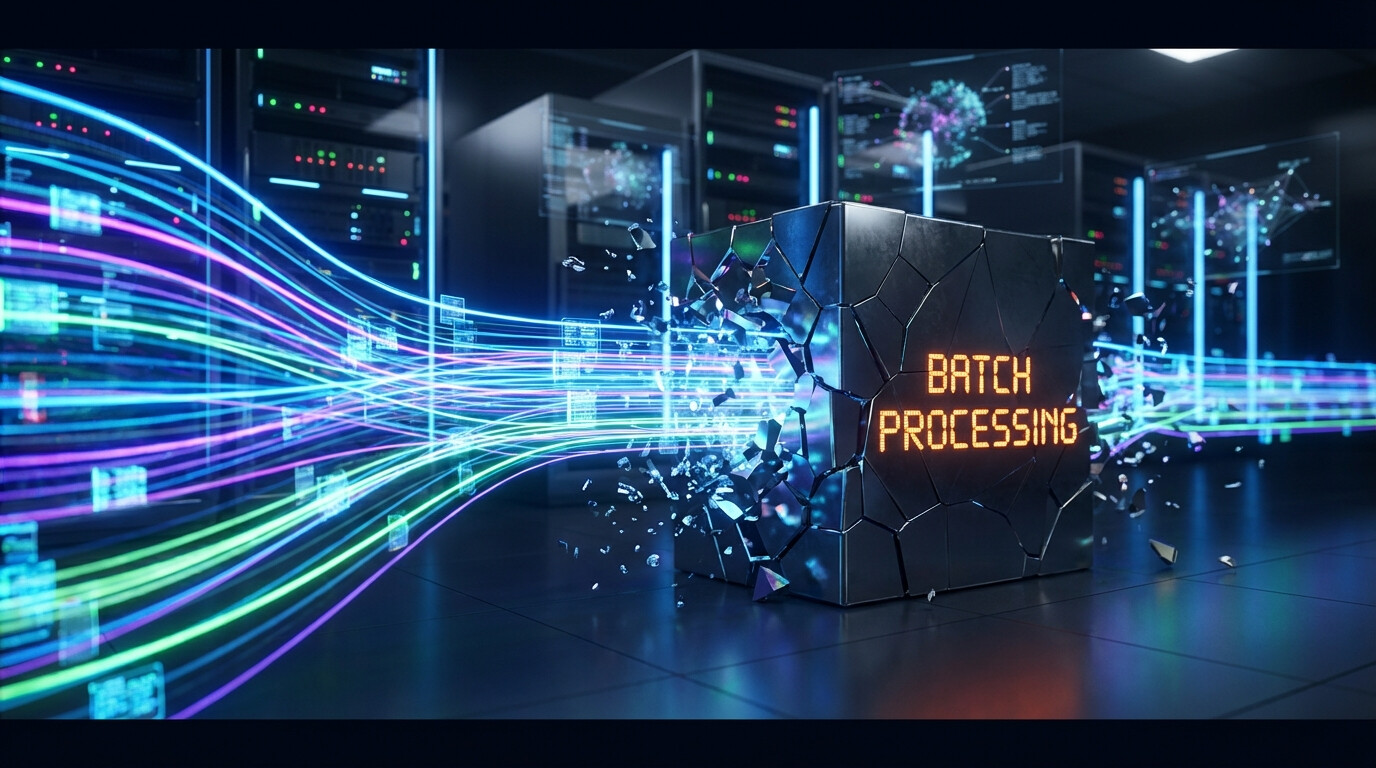
Still training your AI models on yesterday’s data? That’s like bringing a knife to a laser fight. In December 2025, IBM’s $11 billion acquisition of Confluent sent shockwaves through the enterprise AI world - and for good reason. This deal isn’t just about adding another tool to Big Blue’s arsenal. It’s a declaration: the era of static data lakes is officially over.
The Problem: Your AI Is Only As Smart As Its Last Meal
Here's the uncomfortable truth - less than 1% of enterprise data is being used for generative AI initiatives today, while approximately 90% of data remains unstructured and siloed. Even worse, most organizations are still feeding their AI models through batch processing pipelines that update hourly, daily, or even weekly.
Think about that. Your AI is making real-time decisions based on stale information. It's like asking a financial advisor who only reads last month's newspapers to manage your portfolio. By the time your model ingests data, analyzes it, and produces insights, the business landscape has already shifted.
The symptoms are everywhere: recommendation engines suggesting out-of-stock products, fraud detection systems flagging legitimate transactions hours too late, and chatbots confidently providing outdated information. This isn't just inefficiency - it's model obsolescence in real time.
The Solution: Event-Driven Intelligence
Enter real-time streaming architectures. Unlike batch processing, which treats data like discrete chunks to be processed periodically, streaming platforms like Apache Kafka treat data as continuous flows of events. Every customer click, transaction, sensor reading, and system log becomes immediately available for AI consumption.
The performance difference is staggering. Streaming-first architectures with event-driven designs have become the default approach in AI pipelines, enabling low-latency inference, continuous model fine-tuning, and real-time analytics. Organizations adopting these architectures report productivity gains of 26-55% and ROI of approximately $3.70 per dollar invested.
This is where IBM's Confluent acquisition becomes strategic genius. Confluent's platform, built on Apache Kafka, processes millions of events per second with millisecond latency. Combined with IBM watsonx.data, which can improve AI system accuracy by about 40% through unified data handling, enterprises can now build what I call "Hyper-AI" - models that learn and adapt in real time.
The Evidence: Why Streaming Wins
The numbers don't lie. Companies spent $37 billion on generative AI in 2025, up from $11.5 billion in 2024 - a 3.2x year-over-year increase. But here's the kicker: most of that investment is wasted if the underlying data infrastructure can't keep pace.
Consider the technical advantages:
- Latency: Streaming architectures deliver sub-second data availability versus hours or days with batch processing
- Freshness: Models trained on streaming data maintain accuracy as business conditions change, reducing the dreaded "model drift"
- Scalability: Event-driven systems scale horizontally, handling billions of events without architectural rewrites
- Cost efficiency: While inference costs for models like GPT-3.5 dropped over 280-fold from late 2022 to late 2024, streaming reduces redundant processing and storage costs
IBM's watsonx platform already demonstrates this power. Real-world deployments show up to 75% reduction in manual data input and multimillion-dollar savings through AI-powered data integration and automation. Now, with Confluent's streaming backbone, watsonx can ingest, process, and act on data the moment it's created.
The Hyper-AI Future
What does "Hyper-AI" actually look like? Imagine a retail AI that adjusts pricing strategies based on competitor moves detected in real time. A manufacturing system that predicts equipment failures from streaming sensor data before anomalies become catastrophic. A financial model that adapts risk assessments as market conditions shift second by second.
This isn't science fiction - it's the inevitable outcome when AI models have access to continuous, fresh data streams. IBM's AI agents with comprehensive toolsets now support rapid build times of just 5 minutes, complex reasoning, and function calling for workflow automation. Pair that with Confluent's ability to deliver millions of events per second, and you've got the foundation for truly autonomous, adaptive intelligence.
The Bottom Line
IBM's $11 billion bet on Confluent isn't about acquiring technology - it's about preventing the next generation of AI from being DOA due to data starvation. As total corporate investment in AI hit $252.3 billion in 2024, the companies that win won't be those with the biggest models or the most GPUs. They'll be the ones whose AI can learn and adapt in real time.
The stale data trap is real, and it's expensive. Every hour your AI relies on batch-processed data is an hour your competitors with streaming architectures are pulling ahead. The shift from static data lakes to real-time streams isn't a nice-to-have upgrade - it's the only way to power AI that doesn't become obsolete the moment it's deployed.
Welcome to the streaming era. Your models will thank you.