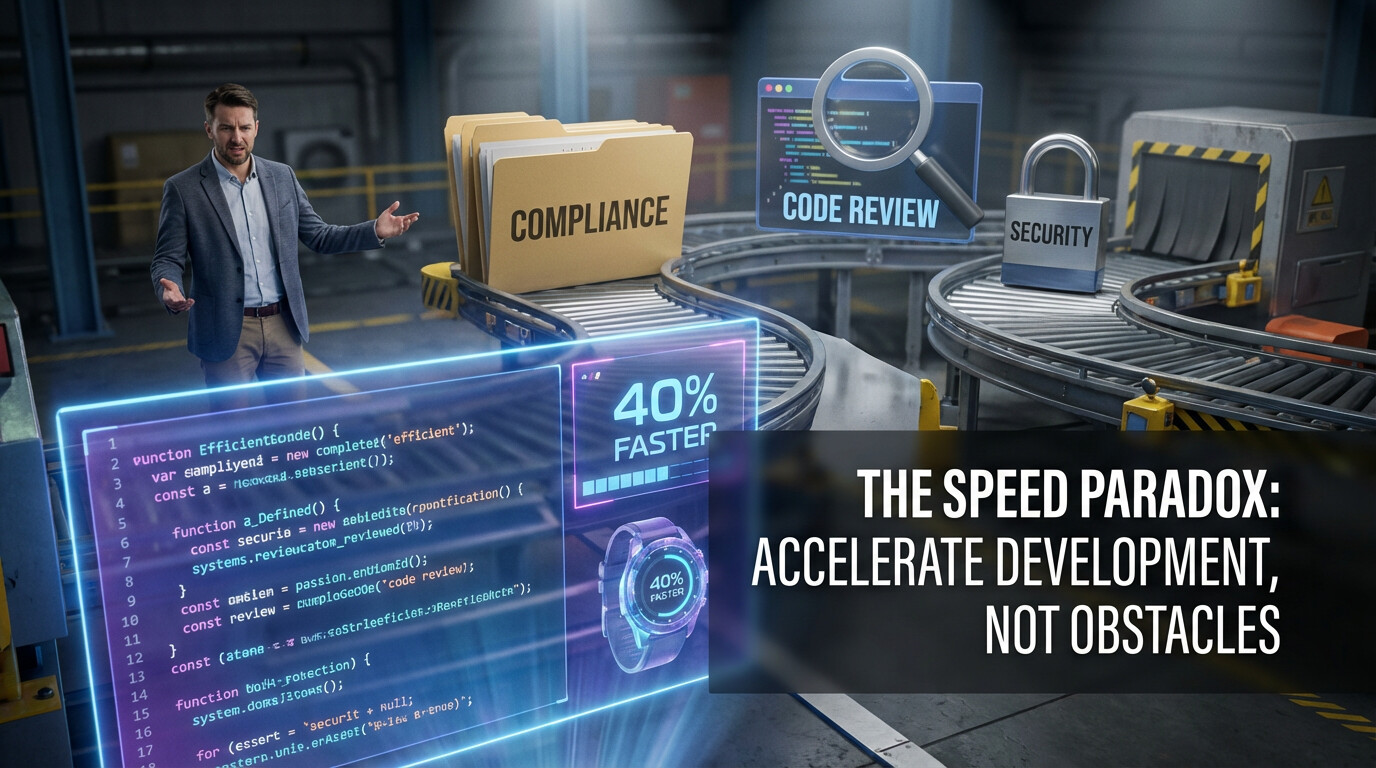
Your developers are coding 40% faster with AI assistants. Your PRs have doubled. Yet somehow, features are shipping at the same glacial pace. Welcome to the Velocity Paradox, where faster coding creates slower delivery.
The Traffic Jam Nobody Saw Coming
Here's the uncomfortable truth: AI coding assistants have become phenomenally good at one thing (writing code) while the rest of your software delivery lifecycle suffocates under the weight of success. In 2025, 78% of global development teams adopted AI code assistants, with 42% of all code now AI-assisted, projected to hit 65% soon. Developers are coding faster, debugging 35% quicker, and feeling productive.
But there's a catch. While teams report coding 40% faster, overall delivery metrics like lead time and defect rates stay flat. One study even found AI users took 19% longer on tasks despite perceiving a 20% speedup. The bottleneck has simply moved downstream, creating a pileup at code reviews, security scans, compliance checks, and documentation.
The 80/20 Rule That's Killing Your Velocity
Coding represents roughly 20% of the software development lifecycle. The remaining 80% (reviews, testing, security validation, compliance, and documentation) has become the new chokepoint. High-adoption teams cut median PR cycle times by 24% (from 16.7 to 12.7 hours) only when they integrated AI into the entire CI/CD process, not just code generation.
The problem? Most organizations automate the easy part (writing code) while leaving the hard parts manual. According to DORA research, faster coding increases PR volume, overwhelming review queues and QA teams. Meanwhile, only 33% of developers fully trust AI outputs, meaning AI-generated code often requires more validation, not less. The result: 88% of teams report negatives like duplicative code and technical debt accumulation.
Where the Real Costs Hide
The neglected 80% of your SDLC is bleeding time and money. Vague requirements and skipped architecture reviews cause 20-30% budget overruns through rework and refactors. Late security scans create vulnerabilities and compliance gaps that trigger downtime and regulatory fines. Documentation bloat (ironically worsened by faster code generation) reduces velocity while adding zero value.
Manual compliance and security processes strain teams as microservices complexity grows. One analysis found the bottleneck has shifted from execution speed to decision quality, with the real constraint now being "how clearly can we define what to build" rather than "how fast can we build it."
Applying AI to the Neglected 80%
The solution isn't to slow down code generation. It's to accelerate everything else. IBM's watsonx platform addresses this through AI-driven DevOps automation that extends beyond coding. Project Bob, IBM's AI-first IDE, provides context-aware assistance for not just coding but testing, debugging, and auditing, with built-in explainability through AgentOps.
Watsonx Orchestrate enables no-code agentic workflows that automate DevOps pipelines from development through deployment, including pre-built agents for compliance, security validation, and documentation generation. The IBM ACE Development Agent goes further, analyzing requirements, generating integration code, creating message flows, and iterating validations across agents to ensure accuracy before human review.
Teams that instrument metrics (using frameworks like DORA) before AI pilots, then add governance for automated reviews, see the real velocity gains. Organizations that achieve 50% faster reviews also achieve 50% higher delivery performance across both throughput and stability. IBM's approach unifies the data and AI lifecycle from ingestion to monitoring, with governance baked in, accelerating deployment times while reducing the manual overhead that kills velocity.
The Path Forward
By 2026, the winners won't be teams that generate code fastest. They'll be teams that automate the entire delivery pipeline. That means:
- Shift-left security and compliance: Automate scans early in the cycle rather than gating releases
- AI-powered code reviews: Use intelligent agents to handle routine validation, freeing humans for architectural decisions
- Automated documentation: Generate artifacts from code and workflows rather than manual writeups
- End-to-end orchestration: Connect AI across planning, development, testing, security, and deployment
The Velocity Paradox isn't a failure of AI. It's a failure to apply AI where it matters most. IBM's 2026 Guide to AI Agents and DevOps automation emphasize this shift: moving from siloed development and operations to collaborative, AI-orchestrated delivery that eliminates the bottlenecks choking your pipeline.
Your developers are ready to ship faster. The question is whether your process can keep up.